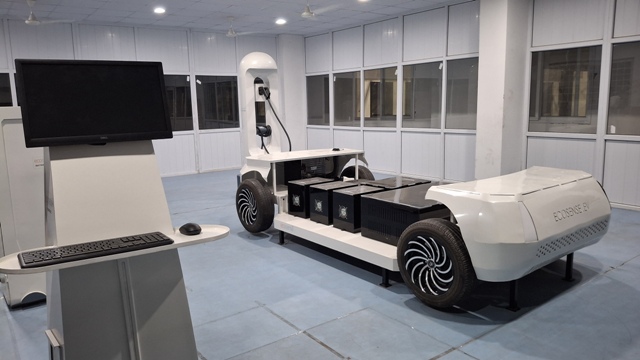
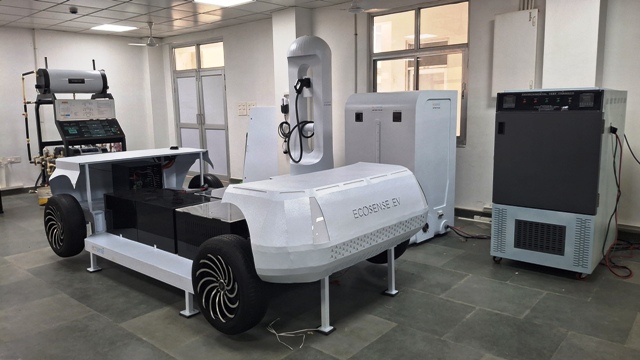
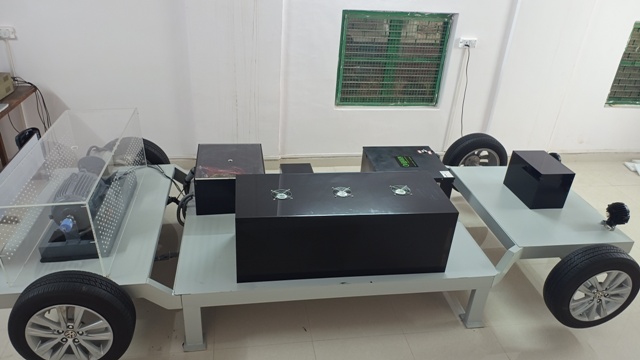
The Ecosense Electric Vehicle Lab is a modular, scalable, and integrated platform designed to provide comprehensive, hands-on learning and research opportunities in electrified transportation. This EV lab setup brings together battery technology, drivetrain systems, and charging infrastructure under one roof, enabling users to simulate, design, test, and validate EV systems in real time.
1. Battery Technology
Battery technology is at the heart of electric vehicles, contributing to nearly 50% of their total cost. Understanding charging, discharging, battery management systems (BMS), and overall performance is critical to EV development. The EV lab setup offers two specialized subsystems for battery research:
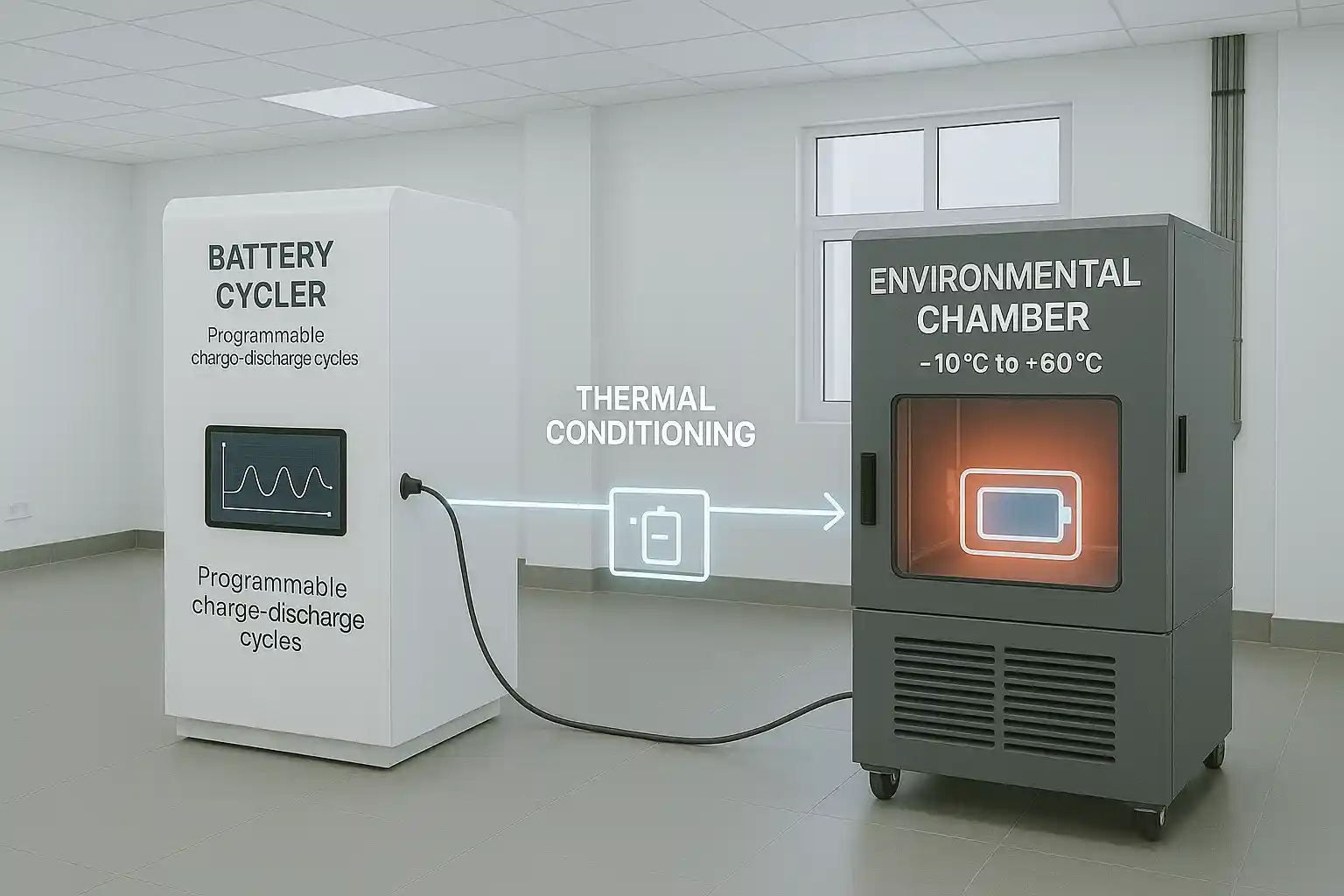
A. Battery Cycler with Data Analytics (BCDA)
This subsystem allows controlled battery testing under varied load and environmental conditions. Users can:
- Evaluate charging characteristics using Constant Current (CC), Constant Voltage (CV), and Constant Power (CP) modes.
- Analyze discharging performance across different load cycles and C-rates.
- Study temperature-dependent behavior using the integrated Environmental Chamber.
- Perform fuel economy comparisons between new and aged batteries.
- Monitor State of Charge (SoC) and State of Health (SoH) to assess capacity and longevity.
The system workflow involves setting up test cases via application software on a PC, which communicates with a microcontroller to control the charge/discharge hardware. Real-time data on voltage, current, temperature, and SoC is logged and visualized for analysis. Users can modify algorithms due to the open-source framework, enabling advanced experimentation within the EV lab setup.
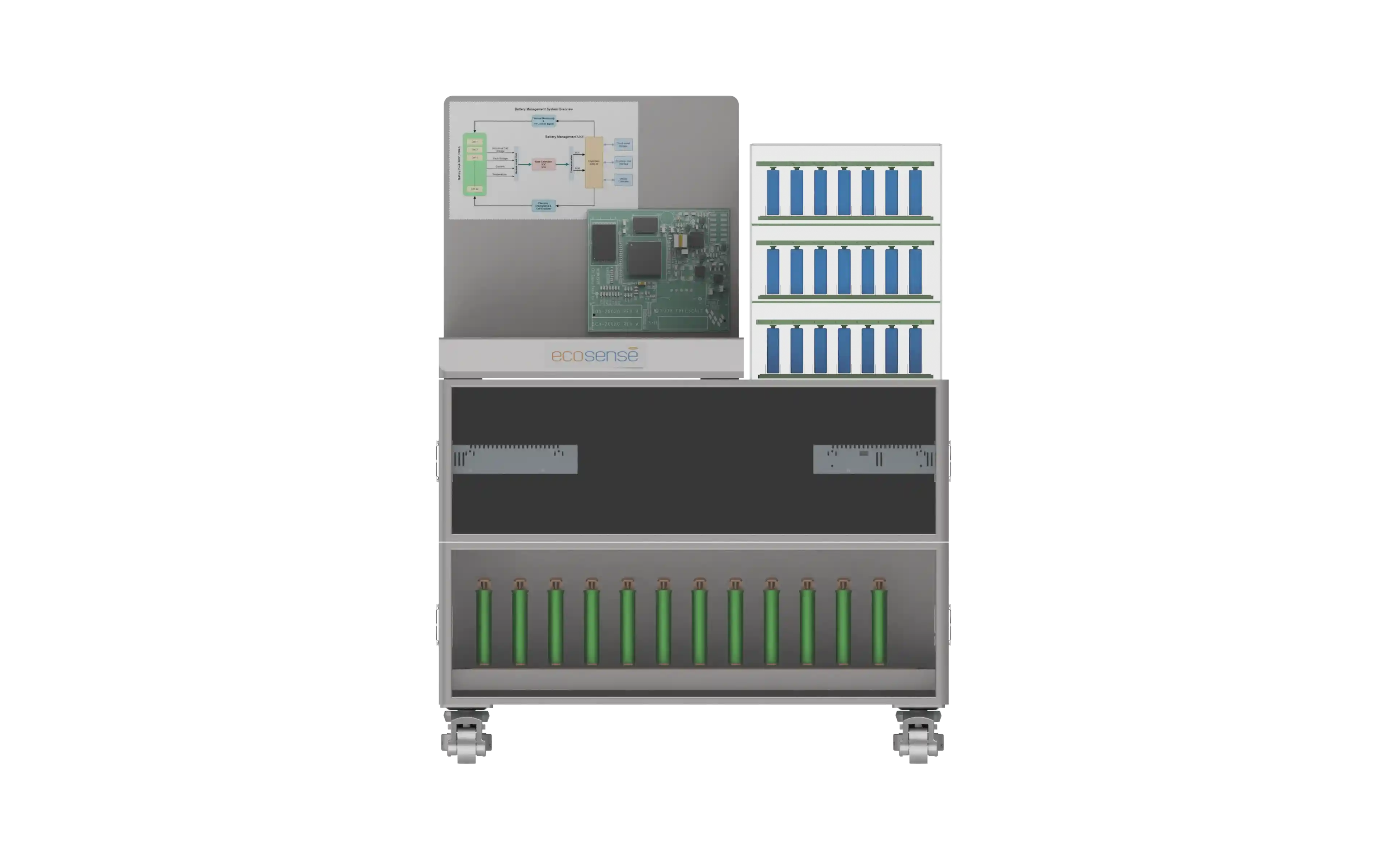
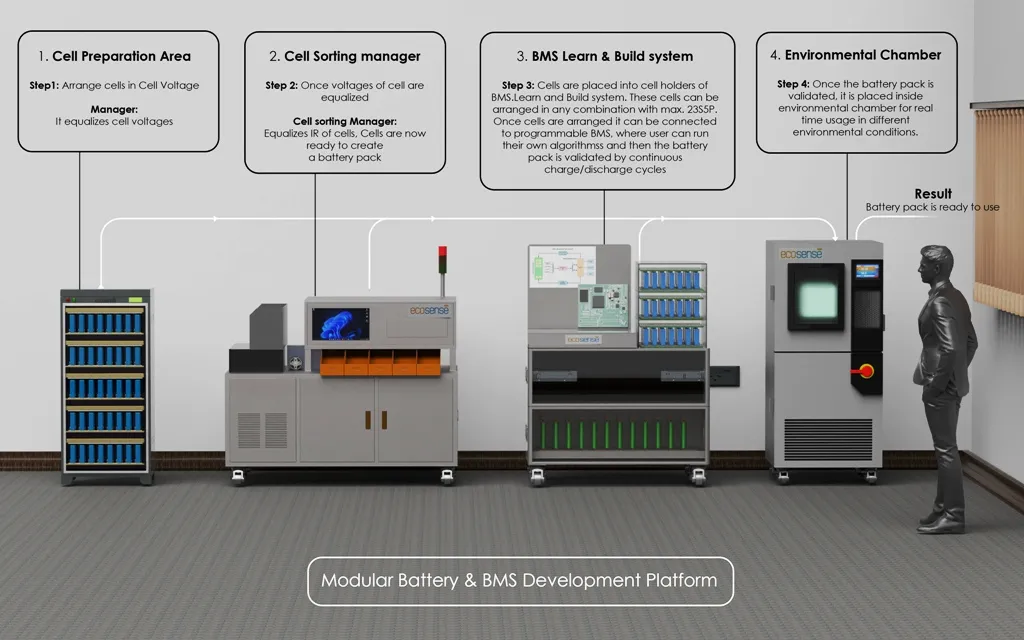
B. Modular Battery & BMS Development Platform
This platform supports battery pack assembly, custom BMS development, and algorithm validation. Key components include:
- Cell Voltage Manager: Ensures uniform cell voltages before assembly.
- Cell Sorting Unit: Groups cells based on internal resistance.
- BMS Development & Validation: Includes monitoring, protection mechanisms, balancing techniques, and SoC estimation algorithms such as Coulomb Counting, OCV, and Kalman Filters.
Integrated with BCDA and the Environmental Chamber, this platform enables complete validation of battery systems under real-world conditions.
2. Drivetrain Technology
The EV Driveline Simulator with Controller Development & Validation Platform enables users to study energy conversion from electrical to mechanical form. The subsystem includes:
- A 5kW PMSM traction motor and PMSM-based dynamometer.
- Programmable motor controllers supporting Field-Oriented Control (FOC) and sensorless operation.
- Integration with traction battery and BMS.
- Drive cycle simulations (IDC, WLTP, NEDC, FTP-75) with regenerative braking.
The system captures real-time data on torque, speed, voltage, and thermal behavior. Users can develop and validate control algorithms and analyze performance under different operating conditions.
3. Charging Infrastructure Technology
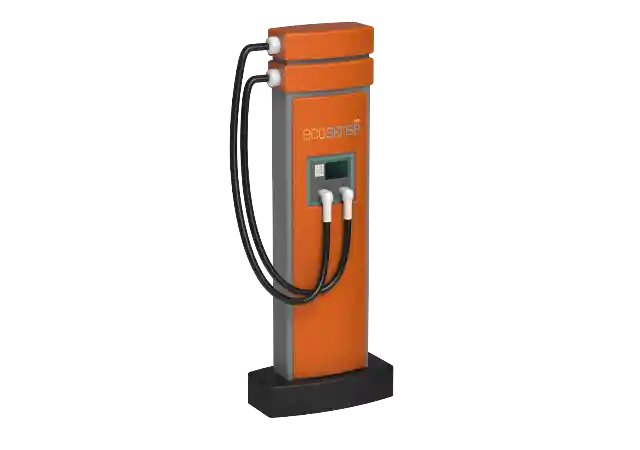
The Modular & Adaptive EVSE subsystem provides a realistic training platform for EV charging technologies. Key features include:
- AC Level 2 slow charging and DC fast charging up to 9 kW.
- Communication with vehicle BMS using standard EV protocols.
- FPGA-based real-time programmable controller.
- Simulation of charging cycles, safety mechanisms, and fault conditions.
Students can experiment with charging profiles, optimize energy flow, and test innovative charging strategies within the EV lab setup.
4. System Integration & Workflow
Each subsystem operates independently but integrates seamlessly into the RTSCET platform for end-to-end EV experimentation. The workflow begins with battery preparation, followed by BMS development and environmental testing. The battery then powers the driveline simulator, enabling motor control and drive cycle studies. Charging experiments are conducted using the same system, completing the full EV ecosystem loop.
By combining hardware, software, and real-time simulation, the Ecosense EV Lab enables users to:
- Understand battery chemistry, performance, and BMS design.
- Study motor dynamics and regenerative braking.
- Explore charging infrastructure and optimization techniques.
- Conduct controlled experiments with real-time data analysis.
Electric Vehicle Lab in Action
EV Lab in Action